Key Highlights
- In Florida, children who are five years of age and younger must be properly secured in a federally approved child restraint (i.e., car seat or booster) whenever they are traveling in a vehicle, regardless of how long their trip is.
- Children aged six to seventeen must wear a seat belt at all times while in a vehicle.
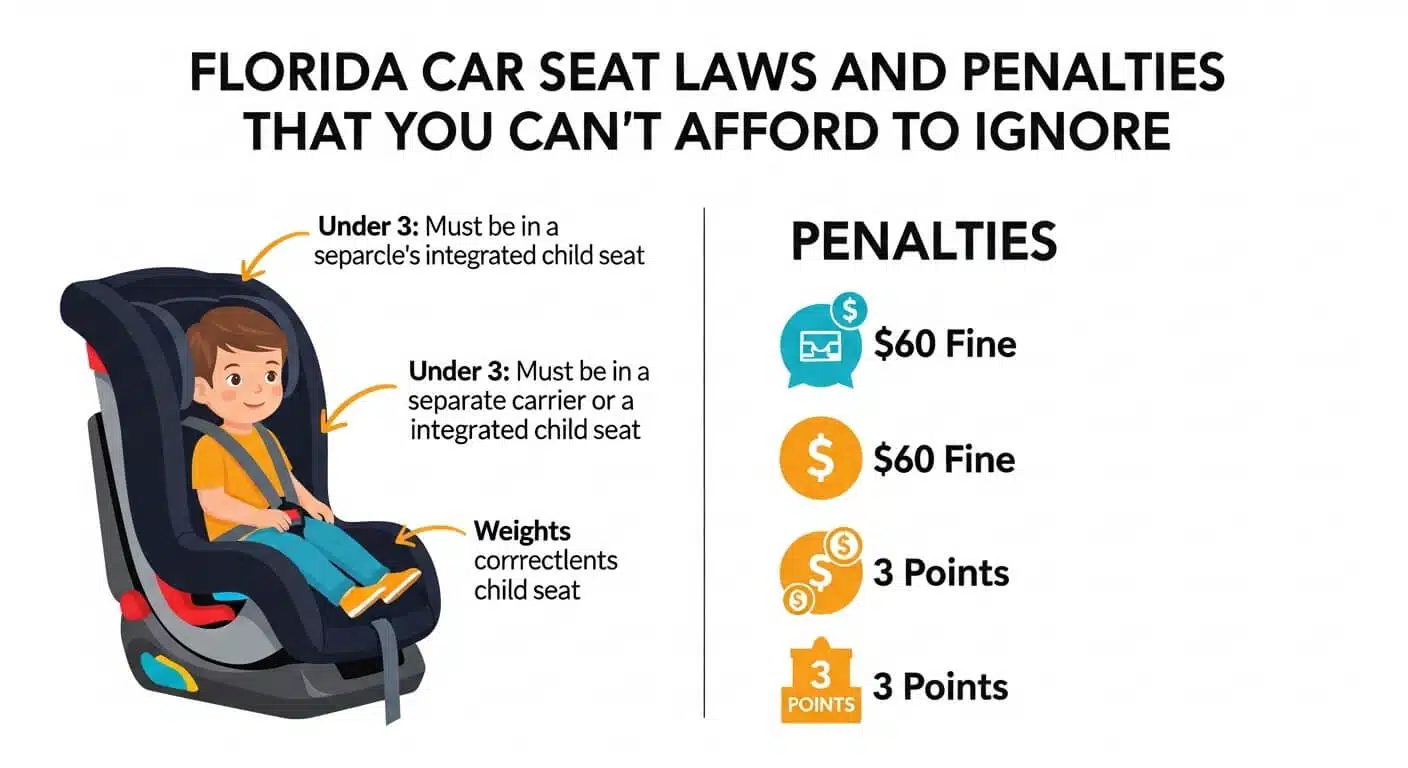
- Violation of child car seat laws Florida may result in a fine of $60 and three points on the driver’s license of the person in violation. In some cases, it may be possible to take a class to satisfy Florida’s child car seat law.
- If you misuse your child’s car seat, it may harm your legal rights when you have an accident, as well as any injury claims you may have.
- Generally, rideshare companies (e.g., Uber/Lyft or taxicabs) are not required to provide a child seat for your child; therefore, you must provide your title or use your own car seat.
What Are Florida Car Seat Laws?
In order to keep children safe, Florida Child Restraint Laws cover all points from when you get into the vehicle until they are old enough to sit in a standard seatbelt. Per Florida Statute §316.613 you must have your child properly restrained in a federally approved car seat that is crash tested for the child’s height, weight and age for every trip, no matter how long the trip is, while the child is younger than 5.
My name is Alex J. Kompothecras, and I specialize in helping families in Florida who have suffered from terrible consequences due to a child’s lack of protection during an accident. In some cases where an accident could have been avoided if the driver had acted differently, the insurance company ensures that they owe nothing and will find ways to deny any obligation. Families feel confused and frustrated about what to do after an accident where their child is hurt. I’m here to tell you that you are not alone in feeling this way!
The attorneys at Alpha Law Group work hard to provide assistance to families across the state of Florida to help them understand their options for filing an injury claim after their child has been injured in a car accident; to find out who is really at fault; and to hold both the negligent driver and the insurance company responsible for the injury and damage done to their family. You can help ensure that you are receiving the best possible service by obtaining a qualified personal injury attorney.
Florida Child Car Seat Laws by Age, Height & Weight
Here’s an overview of the law as it relates to child restraint systems in Florida, including requirements set forth by the state and important recommendations from safety professionals that may not be found in the Florida Statutes.
Understanding the Progression
While children age quickly, their chronological age does not provide the entire picture about the child’s safety. Although Florida law uses age as a measurement for determining the legal minimum, safety professionals suggest that the height and weight of a child as well as the limitations placed on a child by the manufacturer of the car seat be considered in making a decision about whether to make a transition because they are better indicators of safety.
Car Seat Requirements Florida (By Age Group)
Florida does not have a set of minimum height or weight requirements; however, the general rule states that children should continue to be restrained in boosters until they have reached a height of no less than 4 feet 9 inches tall, and a minimum weight of 80 pounds before transitioning to a seatbelt only.
| Child Age | Required Restraint Type | Notes & Safety Guidance |
| 0–3 years | Separate car seat (rear- or forward-facing) | Use rear-facing as long as possible per manufacturer limits, usually to at least age 2. |
| 4–5 years | Separate car seat or booster | Boosters often fit better when the child outgrows harnesses, following height/weight limits. |
| 6+ years | Seat belt in back seat | Seat belt fit (lap/shoulder) matters, the booster may still be safer until tall enough. |
| All under 5 | Must be in approved restraint | Applies regardless of front/back seat position. |
Florida Car Seat Laws: Rear-Facing vs Forward-Facing
Florida law contains requirements for both age and size that must be met in order to legally ride in either a rear-facing or forward-facing position.
Florida Car Seat Laws Rear-Facing
Florida does not have a minimum age threshold for parents transporting children in rear-facing car seat positions; however, it does require that children 0-3 years old be secured per manufacturer instructions before continuing on with their travels. The American Academy of Pediatrics (AAP) recommends that children use rear-facing restraints until they have exceeded the height/weight limit recommended by the manufacturer. By using the rear-facing restraint until they are over the weight and height limits, children are best protected from injury to the head, neck and spine.
Weight limit for forward facing car seat
Parents should keep their child in a rear-facing restraint for as long as possible (typically between 40 and 45 pounds) whether they feel that their child has outgrown the rear-facing restraint or not.
Florida Forward Facing Car Seat Laws
A child is able to forward-face in a child restraint once he or she has exceeded the age restrictions for rear-facing. Per Florida law, there isn’t an age restriction on when you can change from rear- to forward-facing in a child restraint (other than following the manufacturer’s instructions). Thus, there are no laws regarding when you may place your child in a forward-facing car seat.
Booster Seat Laws Florida
Florida State Law 4 and 5 years requires that your child must be in an approved safety seat that complies with Florida State Law in order to travel.
Booster Seat Requirements Florida
- 4 years to 5 years old: Must be in a restraint (either a safety seat or a booster seat).
- Over 6 years of age: Require to utilize a seat belt however, utilizing a booster seat is a safer option until the seat belt fits correctly.
- The proper use of a booster seat is until the child reaches 4 feet 9 inches tall and weighs 80 pounds according to a safety organization. The height will vary based on the physical makeup of the child.
Do not make the transition before your child is ready because many children under the age of 8 may not have a good seat belt fit without the use of a booster.
Front Seat: When Can a Child Sit Up Front?
There is no restriction per Florida Statute regarding the age of children riding in the front seat; therefore, it is legal for a child under 6 years of age to be in the front seat legally provided the child is restrained. However, the AAP recommends that any child under 13 years of age should always be in the rear seat whenever possible due to air bag deployment harming their undeveloped body during an accident (Best practice)
When Can I Transition My Child to a Booster Seat?
A child can transition from using a forward-facing car seat (harnessed) to a booster seat when:
- The child has grown out of the harnessed car seat.
- The booster seat allows the seatbelt to fit correctly on the child.
- The child can remain in an upright position while in the designated seating position for the duration of the trip.
Do Florida Car Seat Laws Apply to Uber, Lyft, or Taxis?
Per official law, taxis, chauffeur-driven, and buses (other hired transportation) are required to have child safety seats only if the parent provides their child seat. Therefore, Uber and Lyft will not provide you a car seat.
If you need a child restraint, you will have to provide your own. This misconception is very frequent, and will result in fines that could have been avoided.
Penalties for Violating Car Seat Laws in Florida
In Florida, not using the mandated use of child restraints is considered a moving violation like DUI:
- Base fines run around $60 and there are 3 points deducted from the driver’s license for a moving violation.
- You may also take a Child Restraint Safety course, under the jurisdiction of the judge who can waive any fines and points incurred upon satisfactorily completing.
Insurance companies monitor these records. If your child is not properly restrained during an accident, the rate that you pay for insurance will likely be affected, even for claim situations that are not your fault.
How Car Seat Violations Affect Injury Claims?
This is where the law and reality diverge:
- According to Florida law, an insurer may not use the improper restraint of a child to prove comparative negligence against the parent in personal injury cases.
- However, the improper use of a child restraint system may affect the value of a claim, as the insurance adjuster may allege that because of the improper restraint your child would have suffered a greater degree of injury than would otherwise have occurred.
- This is where having an experienced trial attorney is vital to assist you in protecting your family and optimizing your recovery.
Case Study: Recovering Compensation After a Child Car Seat Injury in Florida
By Alex J. Kompothecras, Alpha Law Group
After suffering life-altering injuries in a preventable rear-end collision, a young child and her Florida family turned to Alpha Law Group for help. Although the child was fully restrained at the time of the accident, she sustained significant injury as a result of the collision and required immediate emergency medical attention. After the accident, the family spent all their time caring for their injured child, but they became overwhelmed with the difficulties associated with the accident, including worrying about their child’s recovery, accumulating medical bills, not working, dealing with phone calls from the insurance company, etc.
The insurance carrier for the at-fault driver attempted to claim that they were not liable and minimized the extent of the child’s injuries. Evidence indicated that the driver was clearly negligent. Additionally, when the family filed their claim, the first response from the insurer about the child being in an inappropriate car seat caught the family off guard as they believed the insurer would not deny liability based on that issue. Therefore, when the insurer made it clear that limiting payouts were more important than being fair and just was an obvious act of negligence against the family.
Result
With the help of Alpha Law Group, the family’s claim was successfully resolved when the insurer agreed to provide the family with full reimbursement for all of the child’s medical expenses as a result of their injury as well as to provide for any future medical expenses incurred by the child as a direct result of their injury and for lost wages that the family incurred due to the accident. This ultimate recovery was much higher than the original settlement offer the insurance company made, and provided the family with financial security and peace of mind while they focused on their injured daughter.

Conclusion
If you believe your child was injured in a motor vehicle accident because another driver did not take proper care of their vehicle, or if they failed to follow child safety laws, you may be entitled to legal representation by an experienced Florida lawyer. The Florida child injury lawyers at Alpha Law Group will work with you to pursue justice, protect your rights and recover maximum compensation for your child’s medical expenses, future needs, and emotional trauma as a result of the accident.
For more information or to schedule an appointment for a free consultation with an Alpha Law Group attorney, please call (941)-304-1500 and allow us to help your family for a bright future.
FAQs
Can police stop a driver just for a child car seat violation in Florida?
Yes. Police officers have the authority to stop you for a suspected child restraint violation in Florida. It is the same as if you were stopped for a moving violation and is also subject to a primary offense citation.
Do Florida car seat laws apply to rental cars?
Yes. When using rental vehicles, you must comply the child car seat laws of the State of Florida in the same manner as you would with personal vehicles. As the parent or driver of the rental vehicle, it is your responsibility to provide and use an appropriate child car seat for your child.
Does an improperly installed car seat violate Florida law?
Florida law requires that child restraint systems meet all requirements for safety and proper use. Although improperly installing a child restraint system (e.g. using the wrong belt path) may not always result in a ticket.
Can a child car seat ticket increase my insurance rates?
Yes. Moving violations such as child restraint violations result in points on the driving record, which could lead to increased insurance premiums.
Do new Florida car seat laws apply on private property or parking lots?
Typically, traffic regulations only pertain to public thoroughfares and not to private land. Nonetheless, accidents involving injured minors can pose considerable legal exposure and/or safety issues in either context.

"*" indicates required fields