Florida's Personal Injury Protection (PIP) EXPERTS - Advocates for Your Recovery
For Free Consultation: (941)-304-1500
After an accident, uncertainty is natural. Our experienced attorneys are here to provide clear, straightforward answers to help you make informed decisions and move forward confidently.
Get Free ConsultationWe work on a contingency fee basis, meaning you pay nothing upfront. You only pay if we win your case, ensuring no financial risk to you.
Never accept a settlement without consulting an attorney. Insurers often offer less than you deserve. We’ll review your offer and negotiate for full compensation.
In most cases, you have a limited time to file a claim, typically within two to four years, depending on state laws. Acting quickly is crucial.
Accident forgiveness auto policies are frequently marketed as a bonus by most other insurers. Drivers may think that their State Farm first accident forgiveness will be forgiven by insurance companies based on these advertisements. State Farm’s approach, however, is quite different.
I am Alex J. Kompothecras, a Florida lawyer with Alpha Law Group, and we often see Florida drivers who were shocked to find out their accident forgiveness auto insurance premiums increased after an auto accident they thought was an insignificant first-time accident. State Farm does not provide a separate accident forgiveness option for its auto policyholders in Florida, nor does it guarantee protection from future auto insurance premium increases due to an auto accident.
This is most likely why so many Florida insurers promote accident forgiveness as an option, because of Florida’s no-fault insurance laws, which are confusing regarding who pays for what. Understanding how StateFarm Accident Forgiveness operates can save you thousands of dollars in increased premiums over the next several years.
While there are articles that claim that State Farm offers accident forgiveness, they may not be entirely accurate. In fact, the information in these articles tends to mislead rather than inform Florida drivers. Because those who read the articles don’t have all the facts needed to make an informed decision, most Florida drivers would likely be better off without the articles stating that State Farm offers accident forgiveness.
Unlike other companies that market accident forgiveness with an explicit option for customers to purchase, it’s referred to as “accident forgiveness.” State Farm uses accident forgiveness as part of its internal processes. State Farm will only offer accident forgiveness on a case-by-case basis, depending on several factors.
Drivers in the state of Florida should not count on these informal criteria to determine their potential rate increase following an accident, as they are not written down anywhere, they are not guaranteed and they are extremely rare.
If you want to know how your policy will be affected by an accident
Our Florida law firm Alpha Law Group, believes that many times, disputing an incorrect fault determination can save our clients from some long-term negative consequences to their insurance coverage. In Florida, we have discovered that rather than relying on an insurance provider’s “forgiveness,” it is usually more effective to prove liability in order to protect premium payments in the long run.

State Farm hasn’t come out with any type of public accident forgiveness program. They are known to have offered informal accident forgiveness for very long-term customers who have had many years without an accident in certain states, on a case-by-case basis, after the first accident occurred and the customer was found to be at fault.
In Florida, however, this is rare, undocumented, and never guaranteed. So if you’re asking:
The honest Florida answer is: not in any reliable or contractual way.
In most cases, at least at first, yes, State Farm will typically reimburse you for the deductible after it has collected the deductible from the other person’s insurance company through subrogation. Florida drivers are often frustrated by the delay in receiving this reimbursement.
Typically:
This directly relates to:
If an accident occurs for both parties:
In Florida’s shrinking insurance marketplace, non-renewal is a legitimate concern.
By Attorney Alex J. Kompothecras, Alpha Law Group
Following a left turn incident at a crowded crossroad, a Florida motorist FMCSA contacted Alpha Law Group after being informed that State Farm was increasing their premiums. Even though it was their first accident in more than a decade, State Farm determined that the motorist was “at fault” for the earlier incident and, as a result, eliminated the State Farm accident free discount. The motorist believed that the other individual was driving recklessly and/or not focused. Therefore, the motorist thought it was appropriate to obtain an attorney’s assistance.
After conducting an independent review of all of the information, including traffic camera recordings, damage to both motor vehicles, and statements made by witnesses, our firm identified significant discrepancies and inaccuracies in the police report associated with the accident. Based upon the evidence acquired through accident reconstruction, our firm successfully demonstrated that the other party was driving at an unreasonable speed, thereby providing sufficient justification for reclassifying the incident as not “at fault”.
State Farm rescinded its blame on the insured and eliminated the increased premium. In addition, they reinstated our client’s policy. This shows that even if Florida does not offer accident forgiveness programs, having someone legally challenge the determination of the insurer is a viable solution for avoiding a potential increase in future insurance premiums.
Types of coverage determine the amount of compensation available:
Many clients have asked, “How Much Compensation for Anxiety After a Car Accident?”
Typically, the answer requires the client to step outside the No-Fault System through a Liability Claim or Lawsuit.
Is State Farm accident forgiveness a true thing? NO, not in Florida! That’s right, even if you make one mistake with your driving record, it will affect your rates for years.
Being familiar with Florida’s no-fault statutes and knowing when to contest fault makes a huge difference financially. With Alpha Law Group’s assistance, you can properly prepare to handle potential premium increases, non-renewals, and false accusations of fault relating to your accident.
Call (941)-304-1500 today for a free consultation and get clear answers about your options.
For an insurance policy that has Accident Forgiveness, the insured is protected from an increase in the premium because of a first at-fault accident. The Accident Forgiveness feature must have existed prior to the accident occurring and State Farm does not guarantee this provision for policyholders in Florida.
In Florida, an at-fault claim is considered to be an accident where State Farm determines that you, the insured, were responsible or primarily blamed for causing an accident, by using the available information and evidence, statements provided by you and other parties as well as formal/official documentation from Florida law enforcement officials and Florida drivers laws.
Typically, the insurance rate to be paid by customers is raised 15% to 40% for at-fault accidents with State Farm based on how severe the accident was, how many injuries were caused, and whether the policyholder has had other claims and accident-free policyholder discounts before the at-fault accident.
In general, no; however, if you have multiple claims in a period of a few months, this will also impact the underwriting decision, and will happen regardless of whether you were at fault in any of them.
Generally yes, in the beginning. However, State Farm may get back the deductible from the driver’s insurance company, which can take time through the subrogation process.
Many people are shocked to discover that the things they do, and do not do, can easily become legally negligent acts. Just by not noticing a hazard, ignoring safety rules or being distracted while driving can lead to severe legal and financial consequences for another person after an accident occurs.
I am Alex J. Kompothecras of Alpha Law Group and as an attorney, I am regularly retained by individuals who have suffered injuries due to another person failing to act responsibly. Many of my clients originally believed their injury was due to “accidental” circumstances however, once I begin to explain how Florida law regards negligent conduct, I am confident that this misconception will change. Under Florida law, negligent conduct is not predicated on “malicious” intent but rather on the individual’s actions (or omissions) in comparison to a reasonable individual in similar circumstances.
The purpose of Alpha Law Group represents an increase in awareness of what constitutes a negligent action and how negligence impacts our everyday lives (for example, determining fault, filing claims against insurance companies, or being able to sue others due to negligent actions). One of the biggest benefits of understanding baby negligence is the ability to protect yourself from the consequences, whether you want to prevent your own negligence or get compensated for damages you incurred due to someone else’s negligent behaviour.
When someone does not act reasonably in providing care towards someone else in a similar situation, resulting in injury to that person, that person has been negligent.
Legally speaking, tort of negligence (a civil wrong) that causes physical injury and/or damage (i.e., loss or harm). Negligence does not relate to the purposeful intent of the person who caused the physical injury. People are seen as negligent because they are careless (inattention) or have a lack of the ability to carry out some form of a duty (failure to act).
Put simply:
To prove negligence in court, four criteria must exist:
The defendant owed the plaintiff a legal duty to act with reasonable care.
Example: A driver has a duty to obey traffic laws and drive safely.
The defendant failed to meet that standard of care.
Example: Running a red light or texting while driving.
The breach directly caused the injury, and the harm was foreseeable.
The plaintiff suffered real harm, such as physical injury, property damage, or financial loss.
Commonly seen in negligence cases are:
Each example shows someone not acting the way a reasonable person would have acted under the same conditions.
Legal negligence is:
Courts look at these types of negligence when deciding what degree of fault or liability (responsibility) may be assessed in any given case.
The Florida court system depends on the reasonable person standard when establishing whether an individual has committed negligence. The essence of the reasonable person standard is:
Not asking: “What did the defendant believe to be a reasonable action?”
Instead, the court will ask: “What would a reasonably prudent person have done had they found themselves in the defendant’s position?”
Using an objective standard operates as a guide to help both the Judge and Jury to determine whether a person’s conduct fell below the acceptable standard of care or not.
The most important thing to prove negligence would be through the gathering of evidence. The Alpha Law Group concentrates on:
The burden of proof lies with the injured party, which is why early legal involvement is so important.
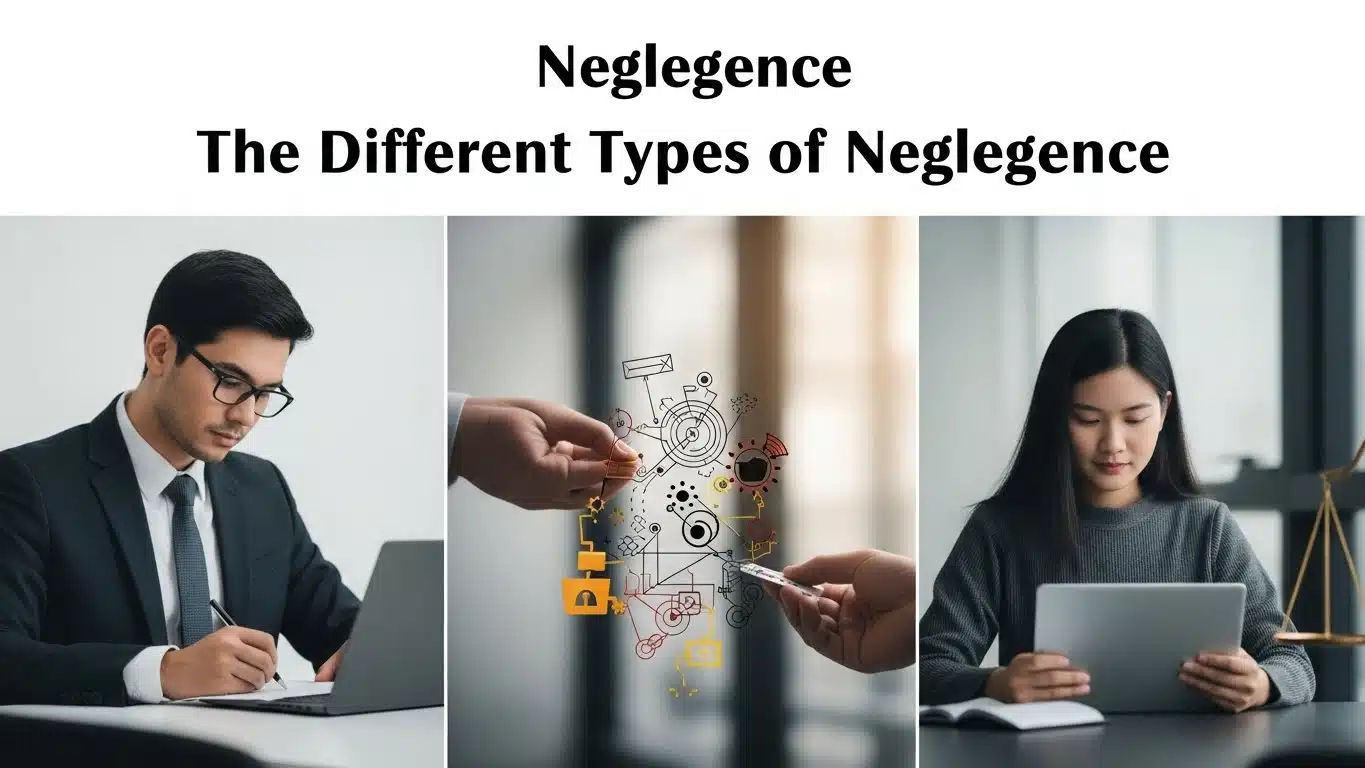
Florida recognizes several types of negligence:
| Type of Negligence | Description |
| Ordinary Negligence | Everyday carelessness |
| Gross Negligence | Extreme lack of care |
| Comparative Negligence | Shared fault reduces recovery |
| Negligence Per Se | Violation of a safety law |
As it relates to the state of Florida, under the state’s modified comparative negligence rule, you cannot recover any damages if you are found to be more than 50% responsible for the incident at hand.
If you are assigned 50% or less of the responsibility for this incident and/or injury you will calculate your entitlement by multiplying your percentage of fault by the amount of compensation that is owed to you by the other party. As such, it is very important to prove that the other party was negligent and to keep your liability as low as possible in order to maximize your compensation.
A lawsuit for negligence is a civil claim seeking compensation for injuries caused by another party’s carelessness.
Typical damages include:
By Attorney Alex J. Kompothecras, Alpha Law Group
In Sarasota, Florida, at an intersection, a driver who was waiting at a red light was struck by an impatient driver of another vehicle. There was evidence to support the driver of the other vehicle’s negligence in causing the accident; however, the driver of the other vehicle stated he could not have avoided the accident and did not take responsibility for the accident regardless of whether he had been negligent.
Reviewing the events that led up to this incident allowed our client to establish that the other driver was not paying attention to the road prior to hitting him, which means that the driver acted negligently.
Our objective was to establish that the other driver acted negligently and that our client should not be found liable for the accident; additionally, we wanted to secure the maximum amount of compensation available to our client.
We gathered call logs from both drivers, collected and reviewed accident reports, and interviewed witnesses of the crash to gather information to support the claim that the other driver was distracted when the crash occurred.
The insurance company has accepted responsibility for the damages caused by the accident and has made a timely reimbursement to our client for the above-mentioned medical costs, lost income, and other pain and suffering. In addition, the case demonstrates that an early determination of a negligent act can significantly impact how a case is resolved.
At Alpha Law Group, we focus on:
We understand how negligence is evaluated under Florida law and how insurers attempt to minimize claims.
Many individuals may view negligence as an easy term to understand, but the implications of negligence can be very serious. Negligent acts may result in injury, damage, lost wages, and extended legal problems following the accident.
Attorneys from The Law Offices of Alpha Law Group have seen the effects of negligence on individuals and families. Educating yourself about negligence and the way it is proven can help you protect your rights and your future.
If you have suffered injuries as a result of another person’s negligent conduct, educating yourself at this time will have a significant impact on your future.
Call (941)-304-1500 today for a free consultation and get clear answers about your options.
When one does not behave responsibly, or when one ignores the laws of nature & their environment, that is simple negligence. In fact, according to the law, negligence is defined as that type of behaviour or conduct; however, many courts have accepted different interpretations based on various types of factors, including actions taken, knowledge, experience, environment, risk factors, etc.
In order to prove negligence, four elements are necessary:
To prove a negligence claim in Florida, you need to provide evidence showing that there was a duty owed to you by the person/business; a breach on their part; an actual connection between the person’s actions and your injury; and quantifiable damages. Evidence can include police reports, medical records, testimony from witness(es), expert opinion(s), etc.
There are several different categories of negligence:
Florida’s Comparative Negligence Statutes provide for a system of comparative negligence, which reduces awards based upon the percentage of negligence, and allows recovery if one party has less than 50 percent negligence.
"*" indicates required fields


